
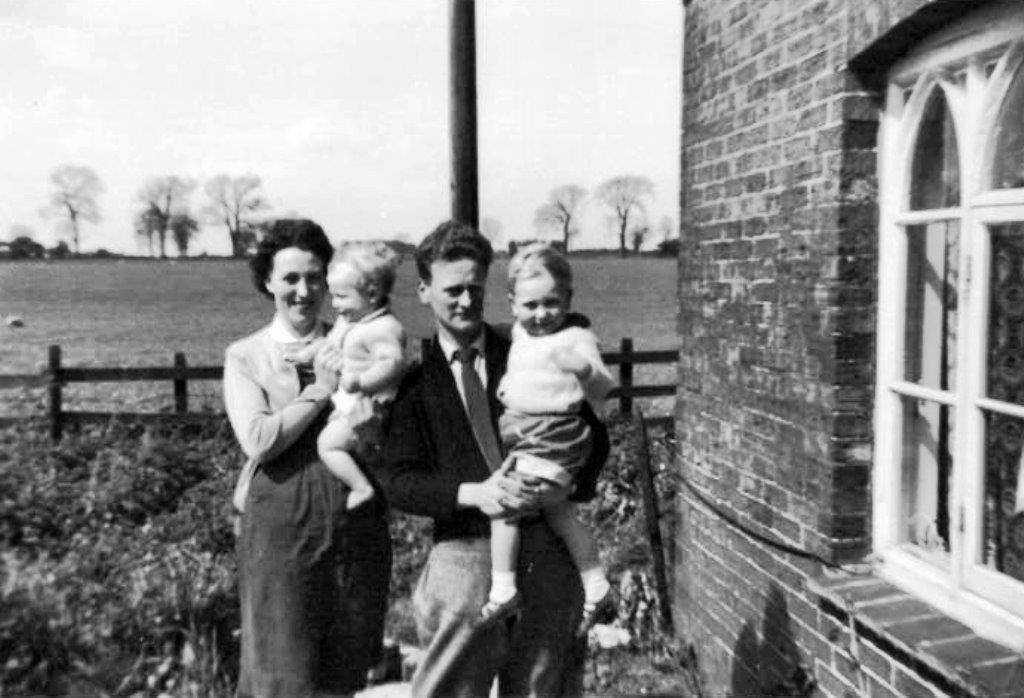
Above: mum, Ian, dad and me in 1961 outside Canister Castle gamekeeper's cottage, Stroxton, Grantham, Lincolnshire (Photo taken by Sandra Noonan).
It has taken me about 6 years to pull the full work together. I have started presenting aspects to test the water. The TIESA slides (see below) give a brief overview of my research method (see goal 2 below).
Contents
- Open up a dialogue with me
- My goals & definition
- Talks, publications and responses
- 7 July 2026. The International Education Studies Association Conference (TIESA)
- 13 July 2026. International Conference of Autoethnography
- Links to related publications and my wider academic work
I invite you to enter my perspective and maybe open up a dialogue with me about my work. You can comment below or email me at johnnigelcook@gmail.com
My work has two goals:
2. Assess the suitability of interpretive autobiography/autoethnography as a method for inquiry into my first goal.
Social mobility definition. The Sutton Trust defines it as the link between an individual’s socio-economic background – the circumstances they grow up in – and their adult outcomes.
Talks, publications and responses
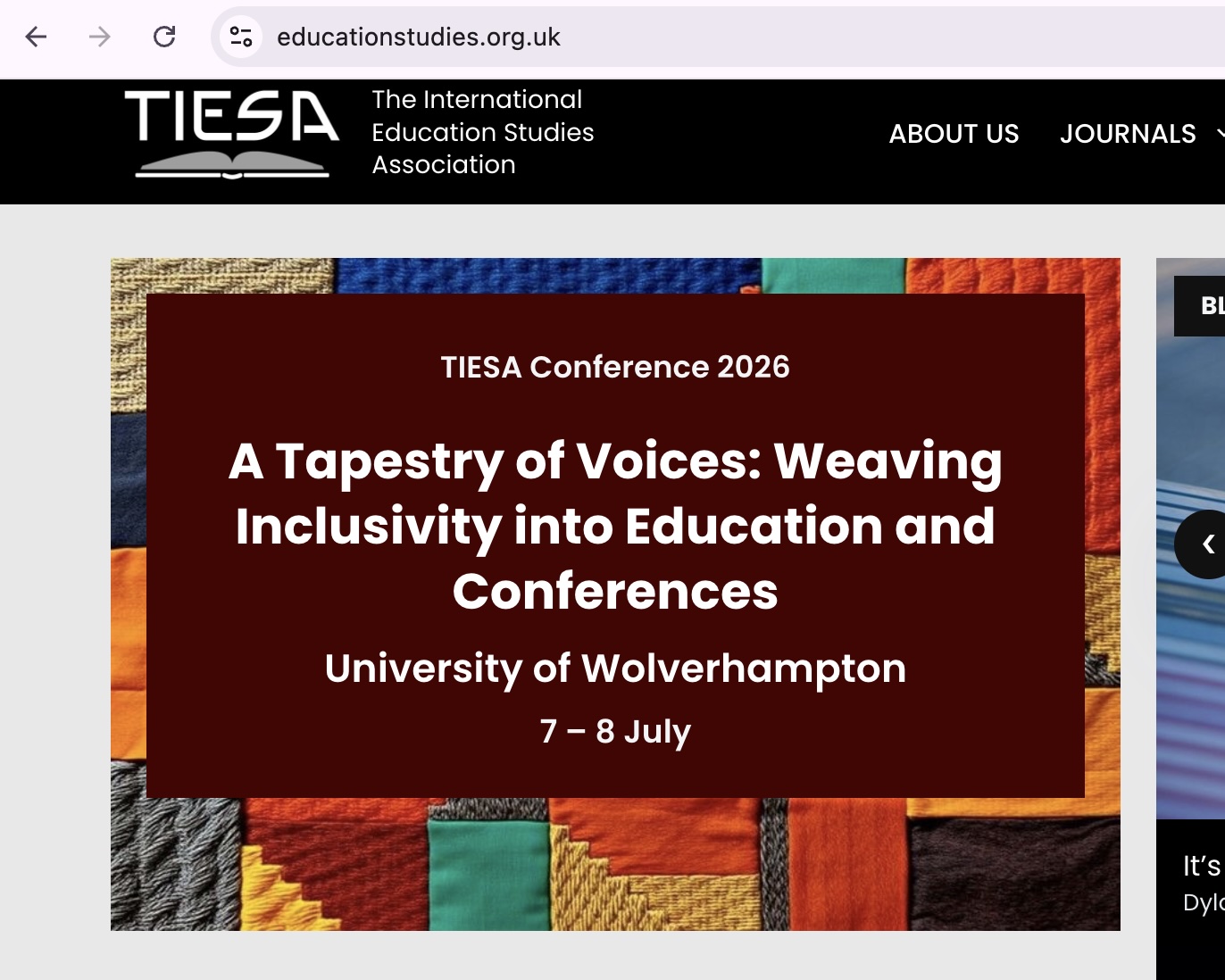
7 July 2026.
The International Education Studies Association Conference (TIESA) (7 - 8 July 2026):
"My journey into the UK's middle-class academia: how adaptability became a part of my social mobility"
Got some good questions in my TIESA conference presentation (Q 1-5 below) and on my Facebook post about this (Q6) and in messages about my ResearchGate post of the slides (comments 7&8). Met some colleagues from my past and made a few new friends. Good conference. The organisers went to great lengths to be inclusive. Also several offers of follow-ups. Watch this space.
- Did your identity-epiphany happen in a single moment or was it gradual? (Session chair).
- I am having trouble keeping my own accent, can you comment with respect to your own experience? (Young black male member of HE staff).
- Did you write a song about any of your epiphanies? (Same as Q2).
- Would you have written this paper if you hadn't already retired from full-time academia and are now an independent researcher? (Female Professor)
- This came up in a book I co-authored, even though we were not specifically looking at class. (Same as Q4).
- I am interested in your views on whether you should have felt compelled to adapt to an unwelcoming, exclusive environment. Drawing on my disability studies background- where arguments are made for adapting the environment not the person- I would also like to ask whether you think HE in the UK has adapted to welcome a more diverse workforce and if not, is it possible for it to adapt? (Female Professor)
- "I have just read your presentation ... and I found it fascinating. Many of the issues you raised resonated with me, even though I am a woman and live and work in a different country". (Female Research Director at a National Research Council).
- "Thanks for sharing your presentation on ResearchGate. I found it very interesting". (Female Professor and former Vice Chancellor).
Dialogue around Q6
My response to Q6: Good questions. A young black male member of HE staff asked me the second question: “I am having trouble keeping my own accent, can you comment with respect to your own experience?” I briefly said I adapted unconsciously in the 1990s onwards. I had my identity-epiphany, the realisation that I had done this to fit in as a HE academic, on 7th December 2022. At first I was horrified, later I realised it allowed me to adapt and communicate without baggage. The nature of the epiphany changed as I developed agency and loose networks. But no one should be compelled to change. Patrick Stewart is from West Yorkshire, in interviews he keeps his accent but on stage and in Star Trek he speaks different, posh. He has personas. I love him!
Paul Wakeling, a Professor at the University of York, has noted on the 20/4/23 about UK Higher Education, that: "whereas there is extensive data about the gender of academics and reasonably good data on self-reported ethnicity, we have almost no systematic data about the social class background of academics". We need more data and cases of Working Class Academics (WCA). I am assuming there is data for disability? You would know … and I have been out of UK HE for 7 years so not sure it has adapted to diversity generally. People like Crew and Wakefield tell us that there are pockets that welcome diversity, including WCA. But in terms of WCA we just don’t have data. In fact Crew (herself a disabled woman) argues that ‘others’ subsume WCA into their own diversity arguments, thus we continue to lose sight of where we are; WCAs must be heard. Would you agree with Crew?
Is it possible to adapt the HE environment? Yes. Make vocational and academic learning of equal esteem (like say Germany) and easy to switch between as people discover themselves. Stop the inequity of unpaid internships for those from families with cultural and social capital (no idea how). For those entering UK HE workforce, use initiative like my Zone of Possibility to help people to build social bridging capital, to help them achieve their goals and to deal with social positioning. That way when they enter UK HE work they are able pose their own versions of key questions. What are the rules? How do I play the game? Who are the players? Bit long of a long reply! Happy to hear counter arguments 
My colleague's further response: There is data on disabled staff in HE- but this requires staff to declare their identity and many dont - for a variety of reasons: for fear of consequences or pride in being able to cope through 'masking'- even though masking can be exhausting and take its toll. I think working class as an identity for academics is invisible/denied because many assume that they are mutually exclusive groups- you cannot be working class and be an academic. An academic belongs to a privileged group in society. When I taught on a new lecturers program in a Russel Group University I made the mistake once of telling them that I failed by A levels and went to a poly- their shock was visible and underpinned by their elitism and beliefs about what 'only accepting the best at our university' entailed. I often wonder how much more stigmatised I would have been if I told them that prior o poly I lived in a council house and had free school meals! I guess I am saying that WCA is probably subsumed into diversity arguments when it comes to academia for a numnber of reasons- because WCA staff mask or adapt and because it never occurs to others tha WCA exist.
My further response: A very powerful set of statements/stories. Thank you for putting over your side, your story and your analysis. You have set me off thinking about how nuanced the reasons may be for WCA becoming 'subsumed' in the debate. And I agree, 'WCA staff mask or adapt' and that we work in an sector where 'it never occurs to others that WCAs exist'. I too messed up my A levels and went to Poly. Your social mobility journey is impressive, I didn't realise. I got to see you come through after me as Chair of ALT, glad I made it to one of your inagurals and you did bring me into the OU to meet some lovely colleagues I have in the background has some other interesting response. For example: "I have just read your presentation ... and I found it fascinating. Many of the issues you raised resonated with me, even though I am a woman and live and work in a different country". (Female Research Director at a National Research Council). You and other colleagues have put me in full-reflection mode. Thank you for your contribution to this evolving dialogue.
Followup interactions LinkedIn (11/07/06):

Link: Mocking people for their class is discrimination – so why don’t we treat it as such? February 24, 2026

Photo of Diane by Smiler
13 July 2026.
"Visiting my younger self in London at a time of squatting, conflict and cooperation: the discomfort resulting from reconstructing my past".
From conference web site: How should I present my work at the ICAE conference?
"There is (fortunately) not an unequivocal answer to this. We encourage you to present your work in a manner that communicates with the audience, in a form you feel comfortable with. We want this to be an inspiring experience for you and the audience. The ICAE is not an “ordinary research conference” where the aim is to present research findings in a scientific IMRAD [*] structure. Thus, PowerPoint presentations with bullet points might not be the best way to share your work. We encourage you to find other ways of presenting – for example reading, performing, photo or film. Feel free – just remember to stick to the [8 mins] time frame"
* IMRAD (Introduction, Methods, Results, and Discussion)
Extract from my performance:
Seeing this 1983 picture of Diane [above] and the prose hit me hard. Diane is shown sprawled unconscious in here party frock, in a corner in King’s Cross, two weeks before her overdose and death. Brown adds:
"Smiler took pic to show her".
When I first saw Diane I felt numb. It often takes a while for my feelings to surface. I had friends that dressed like this in the 1980s for a night out: '50s frocks, shouting into the night, shapes coming out to play. The photo stirred up things inside me. This is my at-risk-epiphany. Now every time I look at Diane I feel deep sadness that we lost her. I don't think I knew her, but she was one of us, part of the at-risk London squatter scene.
YouTube video of my 8 minute slot plus related questions: My performance was well received. My voice cracked as I tried to sing.
My conference performance from Monday 13th July 2026 is available on YouTube (this link takes you directly to it): https://youtu.be/YirgawuWzzM?t=602
My slot starts 10 mins 4 secs into the session video and ends at 19 mins 23 secs. This is followed by Q&A, including some to me.
Link to Three Bop's version of my composition Blue Lights: https://soundcloud.com/threebop/blue-lights
Q&A (from YouTube transcript)
Question: Hi, and thank you to everyone who presented. My name is Bernadette and my question is for squatting in Camden, John. I thought you said you visit in your own film, but don't forget Diane. So my question is about memories and how we remember. Because the idea of a film can be quite a method of romanticising your younger years and that part of your life, but when it comes to Diane, grief is involved. So maybe you could speak to emotion and grief and how that manipulates or changes or sways the way we remember versus romanticising a younger bohemian self. Thank you.
Me: I mean this is something I've struggled with. I gave a talk last week at an education type conference where I talked about how I'm using epiphanies in particular and they can get me a long way. I like the storyfication thing of Herman and Adams and the journal of autoethnography, and I really tried hard to do this. I can do that [storyfication] if it's up to the last 15 years ago. Writing this real kind of very evocative text that brings people into my perspective, but when it gets beyond that, which is what you're talking about, I have real trouble. When I've submitted this abstract [to ICAE] I'll come clean and then I found out that you prefer more artistic type of things like we've been seeing which I thought "well that's brilliant". But then I remembered I'd written this song which triggered it. So this, the lyrics triggered what I was doing at the time because I had trouble, I do have trouble [remembering]. I didn't take that many heavy duty drugs. I did drink a lot but so I mean I didn't pickle myself too much. But it is that, so there's an added thing there's a distance of memory we do mythologize things and in some disciplines it's … I mean I'm a computer scientist though educational, I always got submitted to education for research exercises where you often try and triangulate things [to verify what you think is happening], but I wrote a paper for the journal of Punk and Post-Punk on my time with strawberry switchblade, a female led cult band, an indie band, and people seem to like the fact you can myth mythologize the past. They're thinking, they're saying, people from various sectors [disciplines] they seem to like it. Whereas I am, if you see my abstract [for this conference] I've got this, I'm trying to be as accurate as I can but I understand that I can't be because of memory, because of emotion, because of the mythologizing. But I think finding those lyrics help me remember it a bit better. And the photo [of Diane] just knocked me dead because, I then I remembered all my friends and how we, some of the people I knew that did that; I think she was the sister of the leader of the British National Party, but she used to wear dresses like that and she died of a heroin overdose as well. We used to see her lying around in the streets in Camden. So all these things come back, and some triggers may make them appear.
Question: Have any of you had any experiences of theorising through your arts practice and coming up with with new concepts?
Chair: Anybody want to speak to that question?
Me: [pause] I can take that. It wasn't through art practice but though through the methodology of epiphanies that really did it for me. I mean, there was attached to it certain amounts of, so there was four types of epiphanies for Denzin but the major one was changing my accent when I was working as a lecturer in London in the early 1990s from a northern accent, I'm from West Yorkshire, to try and fit in. And I didn't realise that till 2022 or something like that that "oh god I've I've adapted". So I did, I was a bit ashamed of myself when I realised. But so I found the epiphanies as a framework very helpful. But the art, look I am a musician and I compose and play but I have I've yet to explore it more.

Photo by Halvdan Wettre
Links to related publications and my wider academic work
Related work:
Cook, J. (2022). Outsider Academic – As a Gamekeeper’s Son, I have travelled a long way. Connections with the Edge, December 7th.
A three episode blog. Episode 1 shows the reading and thoughts related to my identity-epiphany.
Cook, J. (2025). A cold case from 1984: Navigating subcultural memory, discomfort and uncertainty. Punk & Post-Punk, 14(1), 27–49. https://doi.org/10.1386/punk_00263_1
Article on journal website or as pre-print
The goal of this article is to provide an account of the difficulty, in the present, of reconstructing a punk event that took place 40 years ago. I will use this undertaking as the basis for reflecting on the larger conceptual stakes (ideas and concepts) that are illustrated by this specific event from the past, the Brockwell Park Festival, London. I played bass at this event in Strawberry Switchblade, a female-led cult post-punk band.
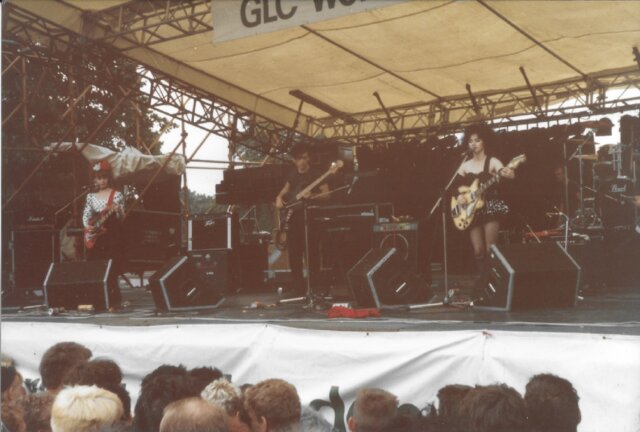
Brockwell Park, 4th August 1984. Photo by Peter McArthur. Me on bass.
Wider academic work:
Tiny url for project overview page: https://tinyurl.com/4xhxtffx (this page)
#socialmobility #class #identity #power #squatting #highereducation #indiemusic